

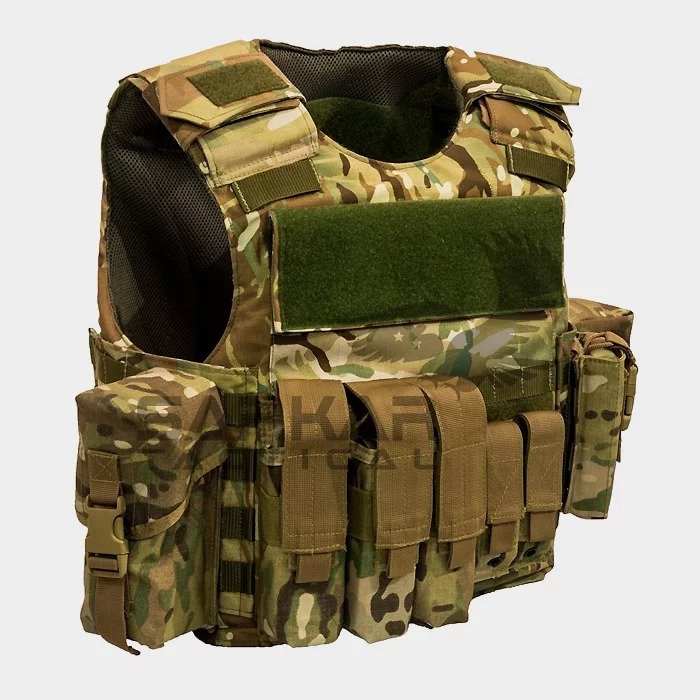
Stab Proof vs Bulletproof Vest: What’s the Difference and Which Do You Need?
One of the most persistent and potentially dangerous misconceptions in personal protection is that a bulletproof vest will also stop a knife. It will not. And equally, a stab-resistant vest will not stop a bullet. The two types of body armour use fundamentally different materials and mechanisms to address fundamentally different threats.
This guide explains – based on materials science and the UK’s CAST testing standards – exactly why this is the case, what each type of vest actually does, and how to determine which protection is right for your role and threat environment.
How a Bulletproof Vest Works – and Why It Fails Against Knives
The Physics of Ballistic Protection
A ballistic vest (more accurately called a bullet-resistant vest) works by catching a projectile and spreading its energy across a large area. When a bullet impacts woven ballistic fibres — Kevlar®, Twaron®, Dyneema®, or Spectra® – the round deforms (mushrooms) against the weave. The fibres absorb and distribute kinetic energy, slowing the round to a stop before it penetrates through.
This mechanism depends critically on two properties: the bullet must deform on impact, and the fibres must be able to catch and hold the deformed round. High-velocity rifle rounds carry too much energy for soft armour to stop — which is why hard ceramic or UHMWPE plates are required for rifle threats.
Why a Knife Defeats Ballistic Fabric
A knife blade does not deform. Its sharp point and edge slide between individual fibres rather than impacting across them. The same weave that catches and holds a mushrooming bullet provides no meaningful resistance to a narrow, rigid blade tip. The fibres part around the blade, which penetrates through the vest.
This is not a failure of quality — it is a fundamental physical difference between a ballistic impact and a blade penetration. No amount of ballistic fibre layering will reliably stop a knife thrust, because the mechanism of protection is simply incompatible with the threat geometry.
How a Stab-Resistant Vest Works – and Why It Fails Against Bullets
The Mechanisms of Stab Resistance
Stab-resistant vests address knife penetration through two principal mechanisms:
- Tight-weave construction — fibres are woven into a configuration so dense that a blade tip cannot force its way through. This typically uses different weave patterns and sometimes different fibre types from ballistic panels — chain-link stainless steel mesh or tightly woven aramid in specific orientations.
- Rigid plate inserts — thin plates of polycarbonate, titanium, or similar rigid materials that physically block blade penetration regardless of blade geometry.
Why Stab Vests Do Not Stop Bullets
The tight-weave and rigid plate approaches that stop a blade provide very poor ballistic protection. A bullet strikes with far greater energy than a knife thrust and at velocities that the rigid or dense materials cannot absorb and distribute. A stab-resistant vest worn against a gunshot threat offers minimal or no meaningful protection.
Multi-Threat Vests — The Practical Solution
How Combined Protection Works
Modern multi-threat vests solve the compatibility problem by layering different materials within a single garment. The vest assembly typically combines:
- Ballistic-rated woven panel — to address bullet threats
- Stab and spike-resistant layer — bonded to or separate from the ballistic panel
These layers work in combination so that the garment meets both the ballistic and the stab/spike requirements simultaneously. The tradeoff is increased thickness and weight compared to a single-threat design.
The UK Standard: HO1 KR1 SP1
Under the Home Office Body Armour Standard (2017), multi-threat vests for UK police are typically certified to HO1 KR1 SP1 — simultaneously meeting:
- HO1 — ballistic protection against defined 9mm handgun threats
- KR1 — knife resistance at 24 joules (CAST standard)
- SP1 — spike resistance at 24 joules (CAST standard)
This combined certification is mandatory for body armour issued to frontline UK police officers.
Which Do You Need? A Role-Based Guide
Security Guards and Door Supervisors
The predominant threat in most UK security roles is bladed or improvised weapons. A stab-resistant vest certified to KR1 SP1 is the minimum appropriate protection. Multi-threat vests (HO1 KR1 SP1) provide additional ballistic protection and are increasingly common among licensed security operatives in high-risk environments.
Police Officers
UK police forces issue multi-threat vests to all frontline officers. The HO1 KR1 SP1 standard reflects the unpredictable nature of police encounters — officers cannot know in advance whether they will face a knife or a firearm. Single-threat armour is not appropriate for frontline policing.
Military Personnel
Military body armour is primarily ballistic-focused, addressing rifle-calibre threats through hard ceramic plates in plate carriers. Stab protection is typically a secondary consideration, though some operational environments — particularly prison escort duties or close-quarter operations — may specify multi-threat capability.
Close Protection and Journalists
Close protection operatives and journalists working in environments where both knife and firearm threats are plausible typically wear multi-threat vests in covert configurations — thin enough to be worn under business attire while providing HO1 KR1 SP1 or equivalent protection.
Frequently Asked Questions
Can a bulletproof vest stop a knife?
No. Standard ballistic vests are not designed or certified to stop knife threats. The material mechanisms are incompatible with blade penetration.
Can a stab vest stop a bullet?
No. Stab-resistant materials do not provide meaningful ballistic protection. Wearing a stab vest against a firearm threat is not protective.
What is a multi-threat vest?
A vest that is certified to provide both ballistic protection and stab/spike resistance simultaneously. HO1 KR1 SP1 is the standard multi-threat certification for UK police.
Which vest do UK police wear?
UK police forces issue multi-threat vests certified to HO1 KR1 SP1 under the Home Office Body Armour Standard (2017).
Choosing Between Stab-Resistant and Ballistic Protection
Stab-resistant and bulletproof are not interchangeable. The physics of blade penetration and bullet impact are different, and the materials that protect against each threat are fundamentally different. For most UK professional roles — police, security, close protection — a multi-threat vest providing simultaneous ballistic and stab/spike protection is the appropriate specification.
Sarkar Tactical manufactures multi-threat body armour in Glasgow certified to UK Home Office CAST standards. Contact our team to discuss your requirements.
Not sure which protection level is right for your role?
